Protection
We defend the dog as a sentient being, never as a product.



Official KAS/WDF pedigrees, canine health and responsible breeding in Slovakia
Official KAS/WDF pedigrees within the international WDF association network, canine health and responsible breeding in Slovakia. Health guides every breeding decision. K.A.S. rigorously reviews the clinical veterinary screening required for breeding dogs in affiliated families, following protocols tailored to each breed. After carefully assessing breeding suitability, it records the results in its registers and, where required, includes them in genealogical certificates, pedigree parchments and official attestations within the K.A.S./WDF system.
Reviewed reproductive health, documented ancestry and responsible selection: the values behind our canine system.
We issue official KAS/WDF pedigrees in Slovakia as a legally registered association with legal personality. They support recognition and genealogical traceability within the international network of WDF affiliates under the relevant rules.
K.A.S. requires reports of clinical veterinary breeding suitability examinations specified for each breed and its known hereditary risks. Veterinarians or qualified facilities perform the examinations; the association verifies the documentation and assesses results under the relevant protocol.
Verified health results entered in K.A.S. registers and, where required, in genealogical certificates, pedigree parchments and official K.A.S./WDF attestations.
Where a programme provides for it, molecular DNA testing complements assessment of hereditary risks, identity and parentage. An international commitment to healthier, more responsible dog breeding.

— K.A.S. · IČO 50662732 —"Health before breeding. Selection before the pedigree. The future of dog breeding begins with responsibility."
Official WDF member · Slovakia
K.A.S. is among the founding members of the WDF project, as personally confirmed by World Dog Federation president Ciro Boiano, according to the KAS owner’s direct account. The association takes particular pride in participating from the origins of this international initiative dedicated to canine health, responsible breeding and genealogical traceability.
The WDF article dated 26 June 2021 documents KAS joining the WDF system after many years of cooperation with the Italian ICBD club and support for its health project. The WDF member list identifies KAS as an Official Member in Slovakia: documented official membership and a historical partnership.
The WDF Global Project for Canine Genetic Health, Traceability and Responsible Breeding connects breed-specific screening, genealogy, genetic diversity, temperament and statistics. KAS supports these aims within the scope of the applicable association programmes.
We issue official KAS/WDF pedigrees in Slovakia as a legally registered association with legal personality. They support recognition and genealogical traceability within the international network of WDF affiliates under the relevant rules.
Being part of this international cooperation is an honour and a commitment for KAS: supporting canine health and a culture of responsible breeding.
Health guides every breeding decision. K.A.S. rigorously reviews the clinical veterinary screening required for breeding dogs in affiliated families, following protocols tailored to each breed. After carefully assessing breeding suitability, it records the results in its registers and, where required, includes them in genealogical certificates, pedigree parchments and official attestations within the K.A.S./WDF system.
Protocols tailored to each breed and its risks put health, function and welfare at the heart of selection, ahead of aesthetic preferences.
Prevention brings together family history, clinical examinations and targeted tests. Molecular results are interpreted in light of the variant, inheritance pattern and breed-specific validation to support informed breeding decisions.

Original reports are kept by the respective breeders and professionals, veterinarians or laboratories. K.A.S. reviews their content for breeding selection without operating a central document repository. It does not systematically retain complete copies of reports and is not a DNA bank or sample archive. Access and disclosure respect confidentiality and the safeguards applicable to breeders’ data.
Molecular DNA tests are distinct from clinical veterinary examinations and complement them where appropriate or required by applicable protocols: specific hereditary risks, identity, parentage and programmes for champions or high-profile breeding dogs. They are not universally required for every puppy. Results concern the variants or markers analysed and are interpreted in the context of the individual dog and programme.
After reviewing the breed-specific clinical veterinary reports and assessing the results, K.A.S. decides on breeding suitability under its procedures and records the decision.
We issue official KAS/WDF pedigrees in Slovakia as a legally registered association with legal personality. They support recognition and genealogical traceability within the international network of WDF affiliates under the relevant rules.
"Health before breeding. Selection before the pedigree. The future of dog breeding begins with responsibility."
KAS × WDF

K.A.S. is among the founding members of the WDF project, as personally confirmed by World Dog Federation president Ciro Boiano, according to the KAS owner’s direct account. The association takes particular pride in participating from the origins of this international initiative dedicated to canine health, responsible breeding and genealogical traceability.
WDF & StandardsReproductive health is the foundation of the K.A.S. model: breed-specific veterinary protocols, careful review of documentation, recording of results and specialist programmes for healthy, informed breeding.
We believe cynology is not a market but a cultural responsibility. Every puppy is a life entrusted to us, never a product in a catalogue. That is why our system places the animal at the centre — its dignity, its health, its future.
We do not believe in random reproduction.
We believe in protocols, controls, responsibility and quality of life.

Every dog is a life entrusted to us, not a product.
We supervise the clinical veterinary examinations required for each breed, carefully reviewing reports and results under association protocols for prevention and breeding selection.
Morphology and temperament assessment under programme rules
Respect for cycles, nutrition and natural timing.
Stimulating environments, hygiene and daily monitoring.
Imprinting protocols and habituation to stimuli.
Veterinarians carry out clinical examinations and laboratories perform analyses; breeding families keep original reports. K.A.S. carefully reviews the documentation, records results in association registers and assesses breeding suitability.
We defend the dog as a sentient being, never as a product.
Respect for biological timing, never forced reproduction.
Veterinarians carry out clinical examinations and laboratories perform analyses; breeding families keep original reports. K.A.S. carefully reviews the documentation, records results in association registers and assesses breeding suitability.
Breeding families and future owners agree information, responsibilities and support in writing, helping every family make an informed decision.
Our philosophy is not limited to genealogical registration.
Our goal is to protect the future of responsible cynology.
— Ethics · Science · Transparency · Welfare —
Philosophy · ethical values · breeding standards · required controls · future vision.
What right do we have to bring dogs into the world if we are not fully prepared to take responsibility for their entire lives?
In a world where dogs are ever more present in families, social media and people's desires, the birth of a puppy can never be a careless act. Every puppy is the result of a human choice — and precisely for this reason it must be guided by knowledge, respect and responsibility.
Breeding is not simply mating two dogs and finding a home for the litter. It means deciding, long before conception, what contribution you want to make to a breed, what future to build, which risks to prevent and which responsibilities to accept.

A pedigree dog is not a product: it is a life entrusted to us.
Never before has there been so much talk about animal welfare, genetics and prevention. Yet the puppy market is still dominated by trends, improvisation and profit. Some breeds are pushed by passing popularity, others modified until they lose function and health. Beauty is confused with excess, selection with appearance, success with the number of puppies sold.

Good selection starts long before conception.
Continuous study and dialogue with vets, geneticists, trainers, judges and serious peers.
Respect for biological rhythms, the well-being of the dam and the dignity of every dog.
Share relevant results and explain their limits. Protect human personal data, but do not use GDPR as a blanket reason to withhold animal reports.
Selection that seeks harmony between morphology, health, temperament and living environment.
Supporting the dog throughout its entire life, far beyond delivery day.
In a society that rewards quantity, visibility and speed, choosing to stop is an act of courage.

Preserving a breed means safeguarding a balance, not repeating a form.
The future of the pedigree dog will depend on the quality of the choices we make today. Every mating can improve or harm a breed. Every litter can be an act of care or an act of carelessness. Every breeder can choose whether to feed the market or to nurture the culture.
To breed ethically is to understand that every birth carries a promise:
to do everything possible so each dog can live a healthy, balanced and respected life.
— Ethics · Knowledge · Respect · Responsibility —

Every breed is an answer to a human question, sculpted by time.
To speak of a purebred dog is to speak of history — the long relationship between people, environment, work and dog.
Every breed was born from a need, a context, a selection shaped over time. Guarding flocks, herding livestock, hunting, protecting, keeping company: each breed carries within itself an answer to a human question and an adaptation to precise conditions.
For this reason a purebred dog cannot be understood by sight alone. It must be interpreted. When its memory is respected, the breed retains meaning. When it is forgotten, the breed risks being reduced to shape, fashion or brand.
A breed is a relatively stable set of physical and behavioural traits transmitted through selection. It allows us to predict, within limits, the appearance, aptitudes and temperament of the offspring. Choosing a purebred dog should not be a matter of aesthetics, but of seeking a companion compatible with one's life.
When a breed becomes only status, fashion or a market tool, it loses its cultural function. The ethical breeder must oppose this reduction: a breed is not a brand to sell, but a heritage to protect.
It explains why a dog has a certain build, certain energies, certain motivations — and why it may or may not suit a particular family context.
Attention, reactivity, sensitivity to stimuli and a constant need for mental activity.
Autonomy, wariness of strangers, deep bond with territory, slow maturation.
Predatory drive, physical endurance, desire to explore and to move.
Social proximity, adaptability, a profound desire for human relationship.
When one dimension is pushed to the detriment of the others, the breed is impoverished. The ethical breeder's task is not to chase a single trait, but to protect the whole.

Every breed is a different memory, each to be protected as a whole.

Every name in a pedigree tells the story of earlier choices.
We issue official KAS/WDF pedigrees in Slovakia as a legally registered association with legal personality. They support recognition and genealogical traceability within the international network of WDF affiliates under the relevant rules.
Without genealogy there is no real breed selection. Yet the document does not replace the competence of the breeder, the health of the parents, transparency and respect for the dog.
"What is this pedigree worth?"
"What does this pedigree tell me, and what responsibilities does it place on me?"
Without typicity — proportions, expression, movement, coat, temperament — a breed loses identity. Preserving it is a cultural duty.
A good breeder does not hand over 'an available male' or 'an available female'. They hand over that puppy, with that temperament, those potentialities and those needs.
A head too heavy, a muzzle too short, an extreme angulation, an unmanageable coat: what was once characteristic can become caricature. Canine beauty should never be separated from health.
The right question is not whether a trait makes the dog more striking, but whether it improves or worsens the dog's life.
When a breed is fashionable, the serious breeder must become even more selective. Inform, explain, discourage those who are not ready. Protect dogs even from those who desire them without understanding them.
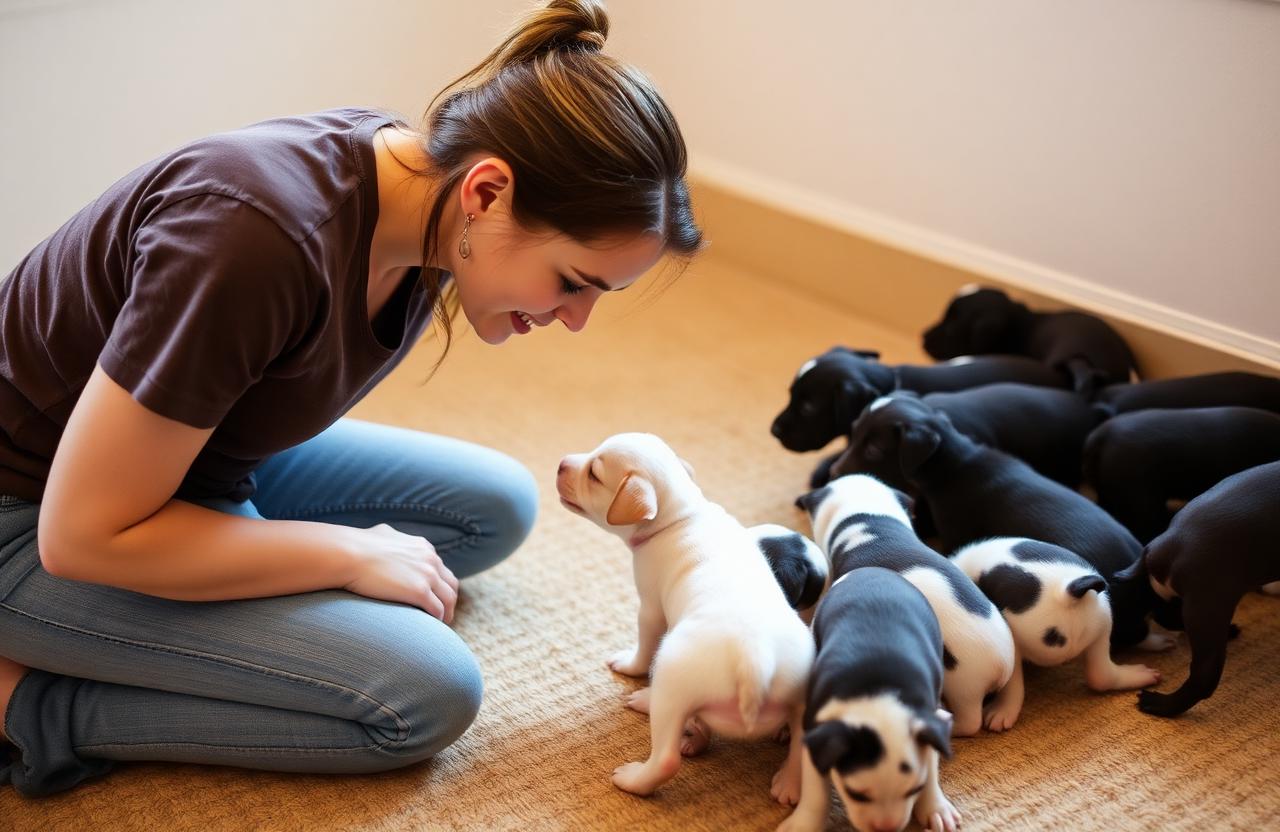
Not an available specimen: that puppy, with its own story.
For the ethical breeder a breed is not a product to replicate, but an identity to protect. Not a trend to exploit, but a heritage to hand down to the future in better — or at least no worse — condition than how it was received.
Understanding the purebred dog means going beyond appearance:
reading in its body the story of a function, a culture, a responsibility.
— Origin · Function · Identity · Responsibility —
Every recognised breed has a standard. It is not an aesthetic catalogue nor a frozen photograph: it is the living description of a breed's functional, morphological and temperamental identity.
At KAS we read the standard as an instrument of responsibility. It tells how a dog should be built to express typicity, balance and coherence with its history — always in the light of health and well-being.
Long before it is written, the standard should live in the balanced body and serene life of the dog.

A typical dog expresses the breed in the most harmonious way — never in the most extreme.
Typicity is what makes a dog recognisable as belonging to its breed, always within a harmonious whole. Exaggeration appears when a single trait is isolated and pushed beyond measure, eventually compromising health, movement or quality of life.
A breed is not improved by making its distinctive traits ever more extreme: it is improved by preserving proportion, balance and function. The ethical breeder always distrusts caricature.
Six principles guide every morphological evaluation and every breeding decision we make.
Every detail is subordinate to overall harmony. The dog is a whole organism, never a sum of parts.
Morphology only makes sense if it allows the dog to breathe, move, work and live without limitation.
The standard is understood in depth, not applied mechanically or bent to personal taste.
No typicity justifies suffering. When an interpretation produces problems, the interpretation must be corrected.
Beauty and stable character are inseparable. We select dogs that are serene, balanced and fit for real life.
A minor aesthetic fault does not weigh the same as a structural fragility or a serious functional issue.

Correct movement is not theatrical: it is efficient, fluid, economical.
A dog may look correct in a static pose, but it is in movement that the structure shows its real efficiency: footfall, drive, coordination, topline, weight distribution.
Movement reveals aspects of physical function, but assessment does not replace diagnosis. Lameness, pain or restricted movement require veterinary attention.
Dog shows are useful tools when set inside a mature cynological culture. They become dangerous when they turn into an absolute goal that rewards excess instead of balance.
A judge assesses a dog within an event’s rules. That assessment is not a veterinary diagnosis, genetic guarantee or general breeding authorisation.

A judgement is one point of view at one moment. Selection requires a much wider vision.

A healthy, balanced dog, able to live serenely in its own body and in its family.
Assessing structure and movement can help identify functional limitations. It does not replace a veterinary examination or guarantee every dog’s health or breeding suitability.
The standard is a compass, never a chain.
Ethical selection always unites beauty and health, typicity and function, form and life.
— Standard · Health · Function · Responsibility —
A puppy is not a product available to satisfy a desire: it is a life born because someone, responsibly, chose to bring it into the world.
Breeding and producing may sound similar. Both lead to puppies, dams, sires, families, paperwork. Behind the surface, however, lie two opposite visions of the dog.
Producing answers a demand. Breeding accepts a responsibility. The difference is not only technical — it is ethical.

Every litter is born from the deliberate choice of those who place the dog before personal interest.

To study, observe, wait: quality always requires slowness.
Ethical breeding takes time: time to study bloodlines, to wait for a dam to mature, to choose the right sire, to raise and observe puppies, to truly know the families.
When someone wants a puppy "right now", we pause. A dog will live for many years: waiting for the right litter, the right individual, the right moment is not a loss. It is part of the responsibility.
Dogs live with affiliated breeding families responsible for daily care, veterinary arrangements and keeping their original documents. KAS performs association-level checks and reviews outcomes. Association suitability does not replace public authorisations or breeders’ statutory duties. KAS is not a puppy retailer.
A good mother must not be exploited because she is good. A precious female must not be consumed because she is precious.
A sire transmits not just image but genetic heritage. Using a fashionable male only because his name sells can narrow the breed's diversity and amplify hidden problems.
The choice of a sire is a cynological decision, not an advertising one. Coherence with the project matters more than the fame of a name.
Saying no is hard: it may mean losing money, disappointing expectations, appearing rigid. But those who always say yes are not selecting — they are merely complying.
The ethical breeder does not merely match puppies and families: they assess whether the match is right. They educate before delivery, support the wait, offer real tools for the years to come.
The seller concludes. The breeder accompanies. A sale may be lost, but a dog is protected — and protecting a dog is worth more than any sale.

Every family meets the puppy guided by those who raised it.

The dog's entire existence — not only the day of delivery.
An ethical breeder does not measure their worth by the number of puppies born, but by the quality of the lives they have helped exist. This is where dog culture finds its highest meaning.
Breeding is not production,
because a dog is not a product.
Responsibility · Transparency · Selection · Relationship

A dog is truly well when body, mind, environment and relationship are in harmony.
If there is one principle capable of orienting every choice in ethical breeding, it is the welfare of the dog. Everything starts here — before beauty, pedigree, titles or market.
The dog's welfare is not an accessory chapter: it is the moral measure of all breeding work. Every decision should be submitted to one simple, radical question.
Does this choice improve, protect or compromise the dog's life? If it compromises it, no tradition, no fashion, no show result can justify it.
Six interdependent dimensions make up the real welfare of every dog in our care.
Breathing, moving, eating, resting, reproducing without conformation turning every act into a pathology.
Emotional stability, stress management, prevention of behavioural fragility from puppyhood onwards.
Sniffing, exploring, playing, communicating, resting undisturbed: every dog must be allowed to be a dog.
Space, light, air, hygiene, safety and stimulation proportionate to the dogs we can truly follow.
Each dog is observed as an individual — never as an indistinct part of the litter.
Human interactions are a source of security and predictability — never of pressure or fear.
If many dogs of a breed breathe poorly, it does not mean that breathing poorly is normal. If many females can only give birth through complex intervention, it is not an inevitable destiny. Frequency does not turn a problem into something acceptable.
Dogs do not speak our language. They show distress in subtle signals: reduced movement, compensatory postures, fatigue, irritability, apathy. The ethical breeder learns to read them — and never treats them as inevitable.
Beauty should never ask the dog to pay a physical price.

Handling, care and check-ups are carried out with calm, consistency and attention to the dog's signals.

Age-appropriate stimuli, variety, gradualness: socialisation is respectful, never chaotic.
The first weeks of life are decisive. Puppies need security, progressive stimulation, positive experiences, respectful handling, environments that are clean but not sterile: sounds, surfaces, objects, calibrated human presence.
A good breeder does not prepare puppies to impress visitors. They prepare them for life — able to meet the new with confidence, not to passively endure it.
A breeder who hides difficulties may sell more easily. But the dog risks paying the price. Truth reduces superficial interest — and protects those who really choose.
Welfare depends on daily care, a suitable environment and timely veterinary attention. A pedigree or association membership alone does not guarantee it.
When human interest and the dog's welfare conflict,
we stand with the dog. Always.
Body · Mind · Environment · Relationship · Time
Download the welfare checklist (PDF)A practical guide for breeders and future owners · 5 pages · A4
dogWelfare.img4Caption
Clear answers grounded in ethics and the daily practice of breeders and families. Every question comes with concrete do and don't guidance you can act on today.
A responsible breeder explains rearing conditions, provides available health records and asks about the dog’s future home. Agree handover and support terms in writing; automatic lifelong guarantees should not be assumed.
Meet the breeder, ask about rearing conditions and request available records for the parents and puppy.
"Welfare is not an opinion: it is a responsibility that must be verifiable."
KAS · Ethics · Transparency · Verification
True quality cannot be measured by a dog's aesthetics alone. For KAS, health is the first criterion of selection — ethical, scientific, non-negotiable.

Clinical findings and internal assessment
Health guides every breeding decision. K.A.S. rigorously reviews the clinical veterinary screening required for breeding dogs in affiliated families, following protocols tailored to each breed. After carefully assessing breeding suitability, it records the results in its registers and, where required, includes them in genealogical certificates, pedigree parchments and official attestations within the K.A.S./WDF system.
Original reports are kept by the respective breeders and professionals, veterinarians or laboratories. K.A.S. reviews their content for breeding selection without operating a central document repository. It does not systematically retain complete copies of reports and is not a DNA bank or sample archive. Access and disclosure respect confidentiality and the safeguards applicable to breeders’ data.
Molecular DNA tests are distinct from clinical veterinary examinations and complement them where appropriate or required by applicable protocols: specific hereditary risks, identity, parentage and programmes for champions or high-profile breeding dogs. They are not universally required for every puppy. Results concern the variants or markers analysed and are interpreted in the context of the individual dog and programme.
HD, ED, breed-specific dysplasias
Periodic clinical examinations
Breed-specific prevention, risk assessment and informed selection guide each breeding pathway.
Verified health results entered in K.A.S. registers and, where required, in genealogical certificates, pedigree parchments and official K.A.S./WDF attestations.
We refuse early, close-kin or aesthetic matings. The female is a subject, not a resource.
K.A.S. requires reports of clinical veterinary breeding suitability examinations specified for each breed and its known hereditary risks. Veterinarians or qualified facilities perform the examinations; the association verifies the documentation and assesses results under the relevant protocol.
Breeding families and future owners agree information, responsibilities and support in writing, helping every family make an informed decision.
Original reports are kept by the respective breeders and professionals, veterinarians or laboratories. K.A.S. reviews their content for breeding selection without operating a central document repository. It does not systematically retain complete copies of reports and is not a DNA bank or sample archive. Access and disclosure respect confidentiality and the safeguards applicable to breeders’ data.
We believe that serious breeding must prevent, control and select responsibly. Not for fashion, not for profit, but as an ethical duty toward every single dog and every family welcoming one.
Health before breeding.
Selection before the pedigree. The future of dog breeding begins with responsibility.
K.A.S. × World Dog Federation